


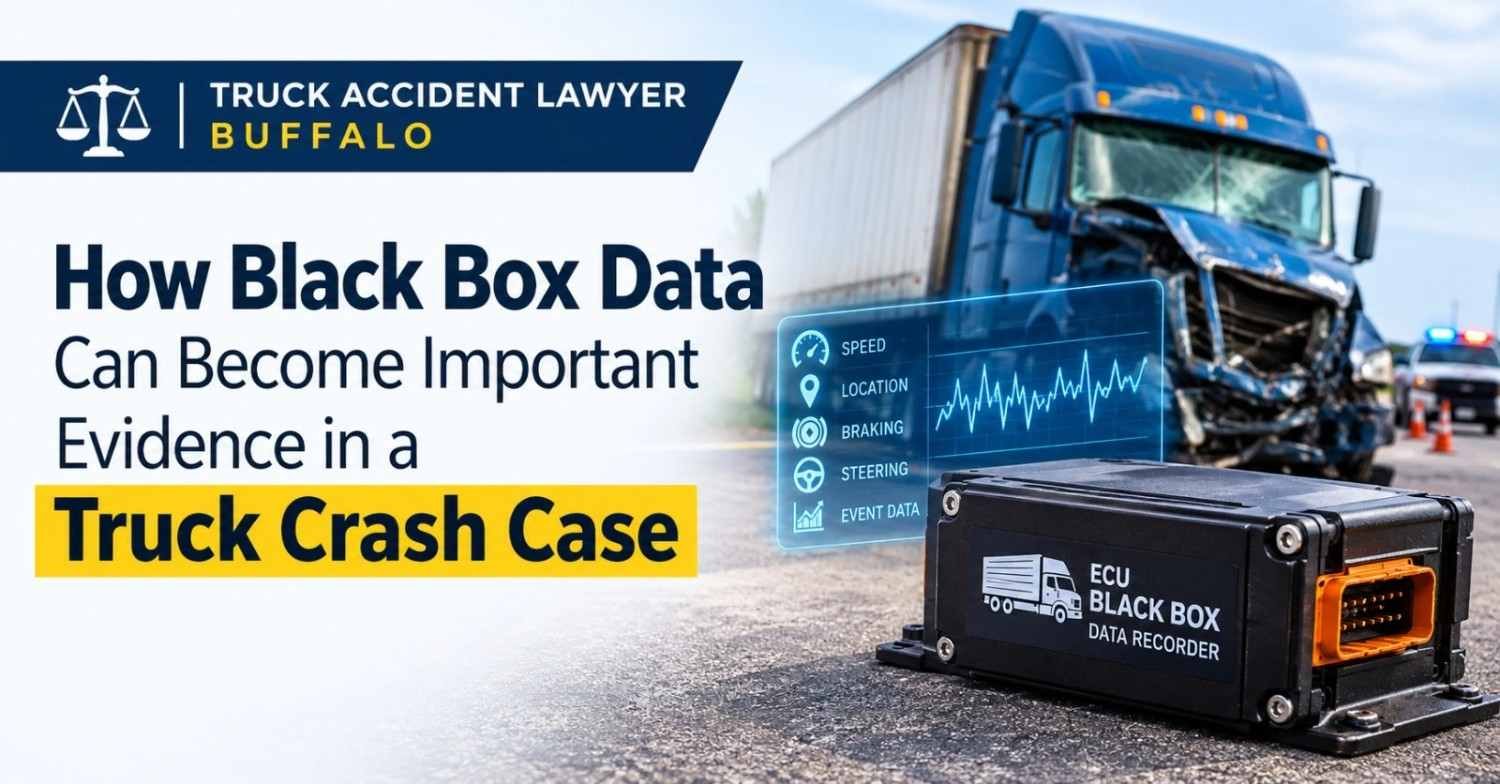
Truck Accident Lawyer Buffalo: How Black Box Data Can Become Important Evidence in a Truck Crash Case is an important topic for people involved in serious commercial truck crashes. There can be numerous sources of evidence in a collision between a tractor/trailer, delivery truck, or other commercial vehicle. Many commercial vehicles are equipped with electronic systems that are meant to collect data on the operation of the vehicle before, during, and in some cases after a collision. The information might be of assistance to investigators when they are interested in the facts of what happened.
Black box information, electronic logging device records, vehicle control module data, GPS information, and other data recorded electronically can be used to determine information about a collision, including vehicle speed, braking, engine activity, driving hours, and other factors. The kinds of information, however, depend on the truck, its equipment, and the systems implemented by the trucking company.
A truck accident lawyer Buffalo can analyze the electronic data along with other evidence such as police reports, photographs, witness statements, medical records, driver logs, and other trucking evidence to help paint a more complete picture of the truck accident.
What Is Black Box Data in a Truck?
Electronic systems that record information about a vehicle’s operation are often referred to as a black box. There are multiple types of electronic systems that can have information that is pertinent to a commercial truck crash.
The information can be from an electronic control module, engine control module, event data recorder, air-brake system, transmission system, or any other computer on the truck.
Such systems may vary from one truck manufacturer to another. Some will log data on the speed, braking, engine operation, accelerator position, or other operating criteria.
Investigators must ascertain what systems the particular truck that was involved in the accident had and what information is stored in these systems.
What Information Can Black Box Data Show?
While the specific information that is available will differ, electronic vehicle data might be able to give information on what the truck was doing around the time of the crash.
| Type of Data | Why It May Matter |
| Vehicle speed | May help establish how fast the truck was traveling |
| Brake application | May indicate whether braking occurred before impact |
| Engine activity | Can provide information about vehicle operation |
| Accelerator position | May help establish acceleration or throttle activity |
| Engine RPM | Can provide additional information about vehicle operation |
| Seat belt information | May be available on some vehicles |
| Crash events | Some systems may record significant vehicle events |
| Time information | Can help establish a sequence of events |
| Diagnostic information | May reveal vehicle system conditions |
Not all of these categories will be recorded in every truck. The information to be made available must be identified for the particular vehicle and electronic systems.
How ELD Data Can Be Different From Black Box Data
The ELD data will also be crucial evidence in a commercial truck accident.
An Electronic Logging Device (ELD) records a commercial drivers hours of service. These records may provide details of a driver’s duty status and driving time.
Black box or vehicle-control data, on the other hand, may provide information about the truck’s operation.
Sometimes the two types of records can be looked at simultaneously.
Investigators, for example, may review ELD logs if a crash happens after a long drive to see if the driver was on the log. They can then check those records against the other evidence related to the driver, route and vehicle operation.
| Evidence | What It May Help Establish |
| ELD records | Driver duty status and recorded driving time |
| Vehicle electronic data | Vehicle operation and crash-related events |
| GPS records | Vehicle location and movement |
| Dispatch records | Assignment and route information |
| Driver logs | Work and driving history |
| Maintenance records | Vehicle inspection and repair history |
If there is a dispute as to what happened in the collision, these records may be especially significant.
Why Black Box Data Can Be Important After a Truck Crash
When multiple parties are involved in a serious commercial truck accident, there can be contradictory narratives. The truck driver might have a different recollection of the accident than another driver or witnesses. It may also be difficult to determine what happened due to road conditions.
You can also get information from electronic records.
For instance, data can be used to help investigators figure out if the truck had been braking prior to impact or if certain vehicle activity was happening just prior to the crash.
Electronic evidence is not necessarily conclusive evidence of legal responsibility. Rather, it can offer facts that are considered along with other facts.
Speed Information and Crash Reconstruction
The speed factor is a consideration in truck crashes.
Large commercial trucks take a lot of space to brake, particularly if they are fully loaded or driven on a fast highway. When reliable speed data is available in electronic information, investigators might be able to compare that data with the physical evidence at the crash scene.
Crash reconstruction may take into account the following:
- Vehicle speed
- Road conditions
- Tire marks
- Damage patterns
- Braking evidence
- Vehicle positions
- Traffic signals
- Weather conditions
- Witness statements
- Electronic records
The wider analysis can help to develop a timeline of the crash.
Brake Data and Emergency Braking
Electronic information concerning braking may be particularly useful in certain truck crash investigations.
Investigators might want to determine if the driver had applied the brakes prior to the crash and when the braking was done.
For example, if a truck struck a vehicle from behind, braking information could potentially help investigators determine whether the truck driver attempted to stop before impact.
Electronic data is not, however, to be taken on its own merits. A variety of other factors can influence stopping ability, such as mechanical issues, roadway conditions, vehicle weight, following distance and more.
ELD Data and Driver Hours
Driver fatigue can be an important issue in some commercial truck crashes. ELD records can be used to help record the driver’s duty status.
An ELD generally records information related to a driver’s hours of service. These records may be reviewed to determine whether the driver’s recorded activity is consistent with applicable requirements and the circumstances surrounding the crash.
An Attorney may request ELD records when there is a basis to determine if driver hours or fatigue is a factor in the accident.
Some other evidence can consist of:
- Dispatch messages
- Delivery schedules
- Fuel records
- Toll records
- GPS information
- Driver communications
- Payroll records
- Previous trip information
These records may provide a more complete timeline at times.
Why Preserving Trucking Evidence Matters
Electronic information may not be available forever. Each system will retain and store data for varying lengths of time.
This is why it is important to preserve potentially relevant evidence after a serious truck crash, as it may be a critical first step.
What might constitute evidence is:
- Black box data
- ELD records
- GPS records
- Driver logs
- Vehicle inspection records
- Maintenance records
- Dashcam footage
- Company communications
- Dispatch records
- Cargo information
- Driver qualification records
- Photographs
- Accident reports
An attorney for a truck accident attorney Buffalo area may make proper requests for preservation, which will minimize the loss of records or overwriting of the relevant records.
Who May Have Truck Crash Data?
Electronic information can be present in various locations in the truck and trucking operation.
These may be caused by the:
- Trucking company
- Truck owner
- Fleet management company
- Vehicle manufacturer
- ELD provider
- Telematics provider
- Maintenance company
- Insurance company
Locating the information can be a critical component of a commercial vehicle accident investigation.
Black Box Data Is Only One Part of Trucking Evidence
It is important not to rely on electronic records alone.
There are several types of evidence that can be included in a strong truck crash investigation. While the black box data can be helpful, other evidence like photographs, physical evidence, witness statements, medical records, police reports and company records can be useful as well.
For example, a photo can capture the damage that allows the sequence of the collision to be explained. A maintenance record may indicate past maintenance of a brake system. Electronic information cannot convey information about traffic conditions that a witness can.
Using multiple sources of evidence can provide a more comprehensive picture.
How Truck Crash Investigations Can Differ From Car Accident Investigations
There may be multiple parties or information involved in a truck accident, making the case more complex.
The investigation will depend on the circumstances and may include:
- Truck driver
- Trucking company
- Truck owner
- Leasing company
- Cargo loader
- Maintenance provider
- Parts manufacturer
- Insurance companies
The precise companies that are involved will rely on the facts of the accident.
An in-depth inquiry into a truck accident may thus involve more than just investigating what the driver was doing just prior to the accident.
Cargo Records Can Also Matter
Cargo can impact a commercial truck’s performance on the road. The weight and placement of a load might affect braking, stability and stopping distance.
The records that support cargo may contain:
- Bills of lading
- Weight tickets
- Loading records
- Delivery documents
- Inspection records
These records may be relevant if investigators think that the weight of the cargo or loading affected the collision.
Maintenance Records and Electronic Evidence
E-vehicle data can be supplemented with a truck’s maintenance history.
For example, if electronic information shows the driver has been using the brakes in an unusual manner, investigators may want to know if the brake system has undergone any recent inspection or repairs.
Records of maintenance can include details of:
- Brake inspections
- Tire replacement
- Steering repairs
- Engine service
- Safety inspections
- Mechanical complaints
- Previous repairs
This information can be valuable to investigators in determining if a mechanical problem could have played a role in the crash.
What Happens If Black Box Data Is Missing?
Not all truck crashes will yield black box data.
Some data may not be available due to the type of truck, restrictions in the recording system, damage to the data, storage restrictions, etc.
Investigators may still look at other types of evidence from trucks even if they don’t have electronic data.
These may include:
- Police reports
- Accident photographs
- Witness statements
- Surveillance video
- Dashcam footage
- Vehicle damage
- Skid marks
- ELD records
- GPS records
- Maintenance documents
- Driver records
- Medical records
It doesn’t mean that the lack of black box information will automatically mean that an investigation is not possible.
How Attorneys May Use Electronic Evidence
Electronic records are part of a larger investigation into a truck accident case that a Buffalo truck accident attorney will undertake.
If technical analysis is required, the attorney will collaborate with accident reconstruction experts, engineers, or other experts.
Electronic records can be utilized to:
- Establish a timeline
- Compare driver statements with vehicle data
- Analyze speed
- Examine braking activity
- Review driver hours
- Investigate vehicle operation
- Identify inconsistencies
- Support accident reconstruction
The intent is to become familiar with the facts rather than making a liability decision based on a single electronic record.
Common Problems With Trucking Evidence
Truck accident cases can involve large amounts of information. Some records may be stored electronically while others may exist in paper or company systems.
Potential challenges include:
| Challenge | Why It Matters |
| Data overwritten | Important information may no longer be available |
| Multiple data sources | Records may need to be compared |
| Damaged equipment | Crash damage can affect available information |
| Different systems | Trucks use different electronic technologies |
| Conflicting records | Information may not always match |
| Large document volume | Investigations can involve extensive records |
Careful organization of these records can aid investigators in determining key inconsistencies.
What Should You Do After a Commercial Truck Accident?
The most important thing to do after a serious truck accident is to make sure you are safe and protected from further harm, and then to seek medical help. After the immediate issues have been resolved, information retention can be important.
Photographs may document, if it is safe to do so:
- Vehicle damage
- Road conditions
- Traffic signs
- Lane markings
- Weather conditions
- Nearby vehicles
- Visible debris
Sometimes it’s helpful to keep contact details for witnesses and keep medical records.
Do not attempt to inspect or remove electronic systems from the truck. Evidence of the technical nature should be addressed in appropriate legal and investigative mechanisms.
How Black Box Data Can Help Establish a Timeline
An advantage of electronic truck information is it can be helpful for investigators to put together a sequence of events. It takes just a few seconds for a serious truck accident to occur, and people on the scene may not be able to remember all the details.
Information on the operation of the truck can be found in electronic records prior to or near the crash. This information, combined with photos, witness statements, traffic signals, road conditions, and vehicle damage, can help investigators establish a more complete sequence of events.
For example, investigators can review whether the truck was going at a steady speed, if the vehicle braked and what happened just prior to impact. The intent is not to use a single data source, but rather to compare several sources of evidence.
Comparing Electronic Records With Driver Statements
While a truck driver’s statement may be significant in an investigation, it does not necessarily provide the only information. If the driver’s account of the accident doesn’t match what is on the electronic record, investigators will look at the cause of this discrepancy.
For example, a driver may remember braking before a collision, while vehicle data may provide additional information about when braking occurred. Neither source should automatically be treated as conclusive. Investigators may need to consider road conditions, visibility, traffic, mechanical issues, and the limitations of the recording system.
A truck accident lawyer Buffalo will examine these differences to see if further investigation is required.
The Importance of Data Preservation After a Crash
When electronic evidence is preserved at an early stage, it can be very useful. Each trucking system offers a different means of storage and the time the data is kept. Some data may be updated or less easily accessible over time.
Restoration programs might include the identification of:
- The truck’s electronic control systems
- ELD records
- GPS and telematics records
- Dashcam footage
- Driver communications
- Dispatch records
- Vehicle inspection records
- Maintenance history
- Cargo documents
- Company safety records
The intent in preserving this information is to preserve potentially relevant evidence in the context of the crash investigation.
Trucking Company Records May Provide Additional Context
The trucking company might hold records outside the truck. These records may tell about the driver’s actions, the direction of travel of the truck and the way the vehicle was being handled.
Records may contain dispatch instructions, delivery schedules, routing information, driver communications, inspection documents, and internal accident reporting documents.
These records may sometimes be used to compare with ELD data and vehicle information. For instance, a dispatch record can indicate the time at which a truck is expected to reach a destination, whereas GPS data can reveal the real-time movements of the truck.
Accident Reconstruction and Electronic Evidence
In complicated commercial motor vehicle accidents, accident reconstruction can be beneficial. A collision reconstruction professional can analyze physical evidence and other information to assess the manner in which the collision may have occurred.
Electronic data can become one part of this process.
A reconstruction may consider:
- Vehicle speed
- Braking
- Impact location
- Vehicle damage
- Road grade
- Road surface
- Weather
- Traffic conditions
- Vehicle weight
- Tire marks
- Driver actions
- Electronic records
Information obtained from these sources can be used to compare and provide a technical explanation of the crash.
Final Thoughts
Truck Accident Lawyer Buffalo: How Black Box Data Can Become Important Evidence in a Truck Crash Case is why electronic information is important after a serious truck accident. Black box data, ELD data, GPS and other information, maintenance, driver, trucking evidence and more can aid investigators in determining what occurred prior to and during a collision.
Electronic records are just one component of a thorough investigation, though. Their value depends on the system involved, the information they have, and the data they have compared to physical evidence and other records.
A truck accident attorney Buffalo victims consult can help them discover what might be important to preserve and review evidence. A detailed investigation may be required to determine the circumstances of a commercial truck crash, as there are many different parties that may be involved in the accident, including drivers, owners of the truck, commercial truck owners, maintenance providers, cargo interests, and others.
Frequently Asked Questions
1. What is black box data in a commercial truck?
Black box data generally refers to electronic information stored by systems within a vehicle. Depending on the truck, the information may include speed, braking, engine activity, and other operational details.
2. Is black box data the same as ELD data?
No. ELD data primarily relates to a commercial driver’s recorded duty status and hours, while vehicle electronic systems may record information about the truck’s operation.
3. Can black box data show how fast a truck was traveling?
Some vehicle systems may record speed information. The exact information available depends on the truck and its electronic equipment.
4. Can ELD data show whether a driver was working too long?
ELD records can provide information about recorded duty status and driving time. Those records may be reviewed when investigating potential hours-of-service issues.
5. How long is truck black box data stored?
The retention period varies by system and vehicle. Some information may be retained for limited periods, which is one reason evidence preservation can be important.
6. Can a damaged truck still contain electronic evidence?
Possibly. A crash may damage some systems while leaving other electronic information available. The specific condition of the vehicle and recording equipment must be evaluated.
7. Can truck GPS records be used in an accident investigation?
GPS or telematics information may help establish vehicle location, movement, routes, or timing, depending on the system used by the trucking operation.
8. Can maintenance records help in a truck accident case?
Yes. Maintenance records may help investigators determine whether mechanical issues, inspections, or previous repairs are relevant to the circumstances of a crash.
9. Does black box data automatically prove who caused a truck crash?
No. Electronic information is evidence that must be considered alongside physical evidence, witness statements, traffic conditions, vehicle damage, and other relevant information.
10. Why can truck accident cases require more evidence than ordinary car accidents?
Commercial truck crashes may involve multiple companies, drivers, vehicles, cargo records, electronic systems, maintenance records, and regulatory documents, creating a broader investigation.