


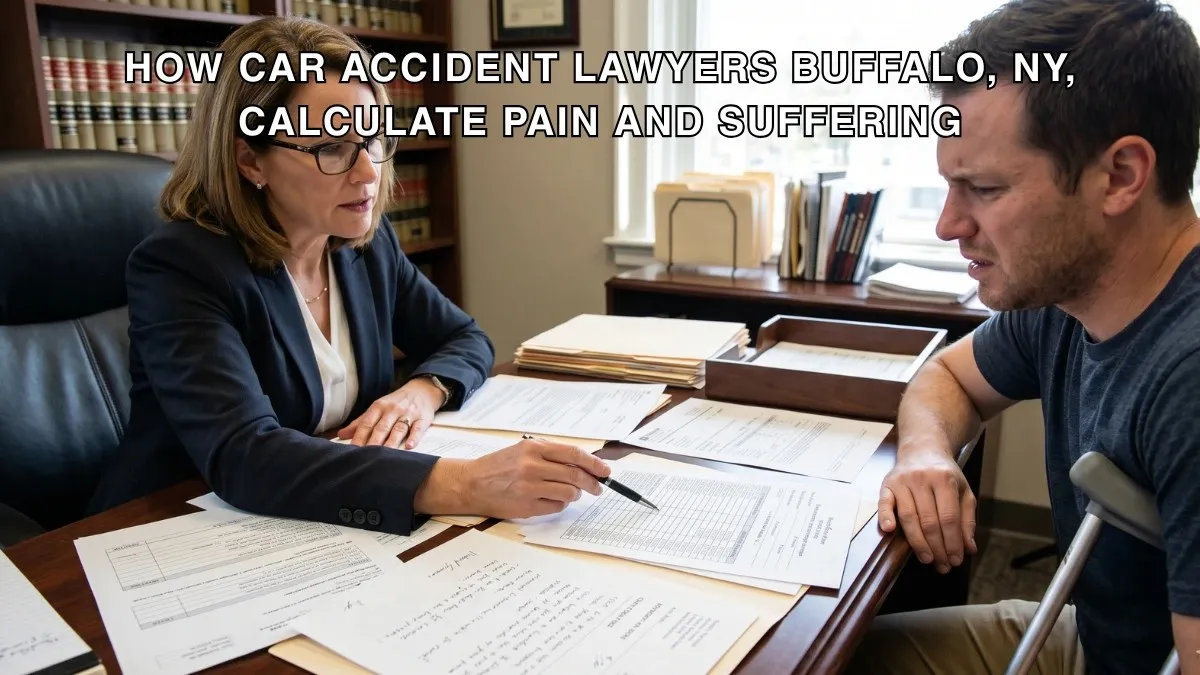
The blog tells about how car accident lawyers Buffalo, NY, Calculate Pain and Suffering. Life can be changed in a few seconds because of car accidents. It is relatively simple to compute medical expenses and car maintenance, but the emotional and physical cost of an accident is much more difficult. This is where the damages of pain and suffering come in as an essential aspect of an injury claim.
In Buffalo, New York, experienced attorneys work to ensure accident victims receive fair injury compensation for both financial losses and the personal impact of their injuries. Understanding how car accident lawyers Buffalo, NY, calculate pain and suffering helps victims know what to expect during a legal claim.
This is a comprehensive guide to the legal techniques, considerations, and approaches accident lawyers in Buffalo, NY, use to assess pain and suffering and secure settlements to the maximum.
Understanding Pain and Suffering in Injury Claims
Pain and suffering are non-economic damages – losses that don’t have a fixed dollar value. The damages are a way of compensating victims of the personal effects of an accident, unlike hospital bills or lost wages.
They may include:
- Physical pain
- Emotional distress
- Anxiety or depression
- Loss of enjoyment of life
- Trauma and mental anguish
- Permanent disability or disfigurement.
Such damages usually constitute a big part of a settlement.
Why Pain and Suffering Are Hard to Calculate
There is no standard price tag for emotional trauma or physical pain. Every accident and every victim is different.
For example, two people may suffer the same injury, but:
- It is possible to heal fast
- The other can acquire chronic pain
- One may return to work
- The other can lose their career
Due to these variations, lawyers rely on established legal formulas and evidence to determine fair compensation.
The Two Main Methods Lawyers Use
Car accident lawyers usually consider two main ways of estimating pain and suffering.
1. The Multiplier Method
This is what is most prevalent among top law firms in Buffalo.
How it works
The economic damages (medical bills, lost wages, property damage) are multiplied by a number between 1.5 to 5.
Formula:
Economic Damages × Multiplier = Pain and Suffering
Example
- Medical bills: $30,000
- Lost wages: $10,000
- Total economic damages: $40,000
If a multiplier of 3 is used:
Pain and suffering = $120,000
How the lawyer selects a multiplier
The multiplier is a factor of the severity of the injury.
Factors include:
- Recovery time
- Long-term medical needs
- Implications for everyday life
- Emotional trauma
- Permanent disability
The multiplier is increased for serious injuries.
2. The Per Diem Method
Per diem means per day.
The approach places an amount of a dollar amount per day of pain and suffering and multiplies it by the recovery days.
Example
- Daily value: $200
- Recovery period: 180 days
- Pain suffering = $36,000
Attorneys tend to calculate the daily value by the daily earnings of the victim or an approximation of the daily suffering.
Key Factors That Affect Pain and Suffering Value
Knowledgeable car accident lawyers Buffalo, NY, look into many details as they develop a claim.
Injury Severity
More severe injuries result in greater compensation, such as:
- Broken bones
- Spinal injuries
- Brain injuries
- Chronic pain conditions
The most common settlements occur as a result of permanent injuries.
Length of recovery
The longer the recovery time, the higher the compensation, since the victims are in pain and are disrupted for a longer period.
Medical Therapy and Recording.
Good medical records are critical. Lawyers rely on:
- Doctor reports
- Therapy records
- Surgical notes
- Prescription history
Comprehensive records are evidence of the severity of injuries.
Emotional and psychological effect
An accident can cause:
- PTSD
- Anxiety
- Depression
- Sleep problems
Claims are enhanced by having a record of mental health treatment.
Impact on daily life
Lawyers will consider the impacts of injuries on day-to-day activities, including:
- Working
- Driving
- Exercising
- Socializing
- Caring for family
Weakness of independence enhances the value of compensation.
Permanent Disability or Disfigurement
Scars, amputations, or disabilities have a tendency to increase settlements as the effects are permanent.
How Lawyers Prove Pain and Suffering
Claims are seldom taken by insurance companies unless they are backed by good evidence. Skilled lawyers obtain evidence like:
- Medical records
- Photos of injuries
- Witness statements
- Expert testimony
- Mental health evaluations
- Personal records of pain
The stronger the claim, the more evidence there is.
The Role of Insurance Companies
Insurance companies try to minimize payouts. They may argue:
- Injuries aren’t serious
- Recovery was quick
- Pain is exaggerated
Senior lawyers are aggressive negotiators to overcome such tricks.
Settlement vs Trial
The vast majority of cases are settled extrajudicially, but qualified lawyers prepare all cases as if they will be tried. This boosts settlement offers.
Professional legal standards are guided by organizations like the New York State Bar Association, which promotes ethical and professional legal practices.
Why Experience Matters in Pain and Suffering Claims
Pain and suffering need legal knowledge, negotiation, and good evidence. Experienced lawyers understand:
- Local court trends
- Jury behavior
- Insurance strategies
- Real settlement values
The result of this experience is usually a significant pay increase.
How Medical Experts Influence Pain and Suffering Calculations
Expert medical testimony is one of the most effective means of hiring skilled car accident lawyers Buffalo, NY. Specialists, doctors, and rehabilitation professionals assist in clarifying how injured victims make their lives different outside of the simple medical expenses.
Medical specialists usually offer:
- Long-term prognosis reports
- Chronic pain evaluations
- Future treatment needs
- Permanent disability assessments
- Analysis of emotional and psychological effects
These expert opinions give insurance companies and juries a clearer understanding of the long-term consequences of an accident. Without expert testimony, insurers may argue that injuries are temporary or less serious than claimed.
The Importance of Future Damages
The suffering and pain are not exclusive to the past. Lawyers are also required to approximate the future pain and suffering, which in severe cases of injury can be huge. The damages that might occur in the future are:
- Ongoing physical pain
- Continued medical treatment
- Future surgeries
- Lifelong therapy
- Reduced mobility
- Long-term emotional trauma.
Attorneys usually use life-care planners and economists to estimate future damages by projecting future costs and changes in quality of life.
This proactive strategy means that the victims do not have to pay years after the accident due to suffering from the accident.
How Lost Life Opportunities Increase Compensation
Hobbies, goals, and life plans are often not undertaken by the victims due to severe injuries. This deprivation of the enjoyment of life is referred to as such by lawyers, and it contributes greatly to the computation of pain and suffering.
Some examples are the loss of the ability to:
- Participate in sports
- Travel comfortably
- Play with children
- Maintain independence
- Continue career growth
These are personal losses, and they are different in cases. Attorneys are keen on recording the lifestyle changes that the victim has gone through after the accident.
The Role of Personal Injury Journals
Numerous lawyers advise clients to record a pain diary daily following an accident. The journal can be used as effective evidence during negotiations with the insurers or when providing a case in court.
A journal can contain:
- Pain levels during the day.
- Emotional struggles
- Sleep issues
- Missing activities or events.
- Difficulty in everyday activities.
In the long-term, such a record builds a strong story of the impact of injuries on daily life.

Witness Testimony and Family Impact
Suffering and pain do not just happen to the injured person but also to his or her family. Some of the statements commonly gathered by lawyers include:
- Spouses
- Children
- Friends
- Coworkers
These witnesses report on personality, abilities, and lifestyle changes in the victim. It is a more relatable and convincing claim due to this kind of testimony.
To take an example, a spouse may tell how the injured individual is no longer able to contribute to the home activities or any other activity in the family. These practical implications enhance the general argument.
How Comparative Negligence Affects Compensation
New York has a comparative negligence rule, such that damages can be minimized in case the victim is guilty to some degree.
Example:
- Total damages: $200,000
- Victim found 20% at fault
- Final compensation: $160,000
Skilled lawyers strive to reduce the degree of blame on their clients. Eliminating even a percentage of blame can greatly contribute to the ultimate settlement.
How Insurance Companies Try to Reduce Pain and Suffering
Insurers have numerous tactics for reducing payouts. Common tactics include:
- Requesting recorded statements
- Supervision of social media usage.
- Questioning medical treatments
- Quick low settlements
- Arguing pre-existing conditions
Seasoned lawyers are aware of how to negate such tricks and guard the client against uttering or performing any action that could jeopardize their case.
Allstate Insurance Company and other huge carriers like Allstate have teams that work towards reducing payouts. Expert legal services can even the playing field.
Why Social Media Can Affect Your Claim
Lots of accident victims do not know that their posts on social media can be considered as evidence. The postings are usually checked by insurance companies to locate any evidence that does not support the injury claims.
For example:
- Vacation photos
- Gym check-ins
- Activity posts
- Comments of feeling fine.
During an ongoing claim, lawyers usually encourage their clients to avoid using social media.
Negotiation Strategies Used by Top Law Firms
The art of negotiating pain and suffering damages is a skill that is gained over a period of time. Attorneys use strategies such as:
- Submitting evidence packages.
- Using expert witness reports
- Showing financial impact in the future.
- Highlighting emotional trauma
- How to prepare good trial arguments.
Ethical and effective legal representation is assisted by the help of professional standards and guidance provided by organizations such as the American Bar Association.
When Pain and Suffering Cases Go to Trial
Even though the majority of claims are settled, others proceed to trial in cases where the insurers do not pay fair compensation. Trial attorneys:
- Medical expert testimony
- Witness statements
- Accident reconstruction
- Physical signs of injuries.
- Economic projections
True tales of suffering frequently awaken the responsiveness of juries and may lead to higher awards than settlement proposals.
The Emotional Toll of Serious Accidents
Pain and suffering compensation is the acknowledgement that injuries have more than a financial impact. Many victims experience:
- Anxiety about driving
- Fear of accidents in the future.
- Chronic stress
- Depression
- Changes in personal relationships
These emotional impacts may be long-term even after physical injuries have been repaired, and hence they are a key component in a claim.
Why Early Legal Help Matters
The faster a lawyer starts working on a case, the more evidence he will have. Early legal intervention is assistive:
- Preserve accident evidence
- Document injuries immediately
- Avoid damaging assertions to the insurers.
- Link victims to medical experts.
- Establish a more powerful argument.
Provision of pain and suffering may be harder due to delays.
The True Value of Experienced Representation
It is an art and science to calculate pain and suffering. It requires:
- Legal knowledge
- Medical understanding
- Negotiation expertise
- Courtroom experience
Senior lawyers understand how to use a powerful narrative supported by good evidence. This combination normally results in increased settlements and improved results in the case of accidents.
Final Thoughts
Damages of pain and suffering are essential in compensation for injuries caused by a car crash. Although no specific formula exists, seasoned accident lawyers in Buffalo, NY, apply tested techniques, facts, and bargaining tactics to ensure the victims are given fair compensation.
And in case you are injured, consulting experienced attorneys will help you guarantee that your physical, emotional, and financial recovery is all taken into account in your claim.
FAQs:
1. What is pain and suffering in a car accident claim?
Pain and suffering refer to non-economic damages like physical pain, emotional distress, anxiety, and reduced quality of life after an accident. These damages compensate victims for hardships beyond medical bills and lost wages.
2. How do lawyers prove pain and suffering?
Lawyers use medical records, therapy notes, expert testimony, photos, witness statements, and personal journals. These forms of evidence show how injuries impact daily life and strengthen claims for fair compensation.
3. Is there a limit on pain and suffering damages in Buffalo, New York?
New York does not place a strict cap on pain and suffering damages in most car accident cases. Compensation depends on injury severity, evidence quality, and how the accident affected the victim’s life.
4. How long does it take to receive compensation?
Some claims settle within months, while complex cases may take a year or more. The timeline depends on injury recovery, evidence gathering, negotiations, and whether the case goes to court.
5. Can emotional trauma increase compensation?
Yes. Conditions such as anxiety, PTSD, depression, and sleep issues can significantly increase pain and suffering compensation when properly documented by medical or mental health professionals.
6. What injuries usually lead to higher settlements?
Severe injuries like brain trauma, spinal damage, permanent disability, or disfigurement often result in higher compensation because they affect long-term health, work ability, and daily life.
7. Do minor injuries qualify for pain and suffering?
Yes, even minor injuries may qualify if they disrupt daily life or cause ongoing discomfort. However, compensation is typically lower compared to serious or long-term injuries.
8. Can social media affect my injury claim?
Yes. Insurance companies may review posts to find evidence that contradicts injury claims. Avoid posting activities or comments that could suggest you are not seriously injured.
9. What happens if I’m partially at fault for the accident?
New York’s comparative negligence law allows compensation even if you share fault. However, your total settlement may be reduced based on the percentage of responsibility assigned to you.
10. Why should I hire an experienced car accident lawyer?
Experienced lawyers understand negotiation strategies, evidence requirements, and local court trends. Their expertise often results in stronger cases, higher settlements, and better overall outcomes for injury victims.