


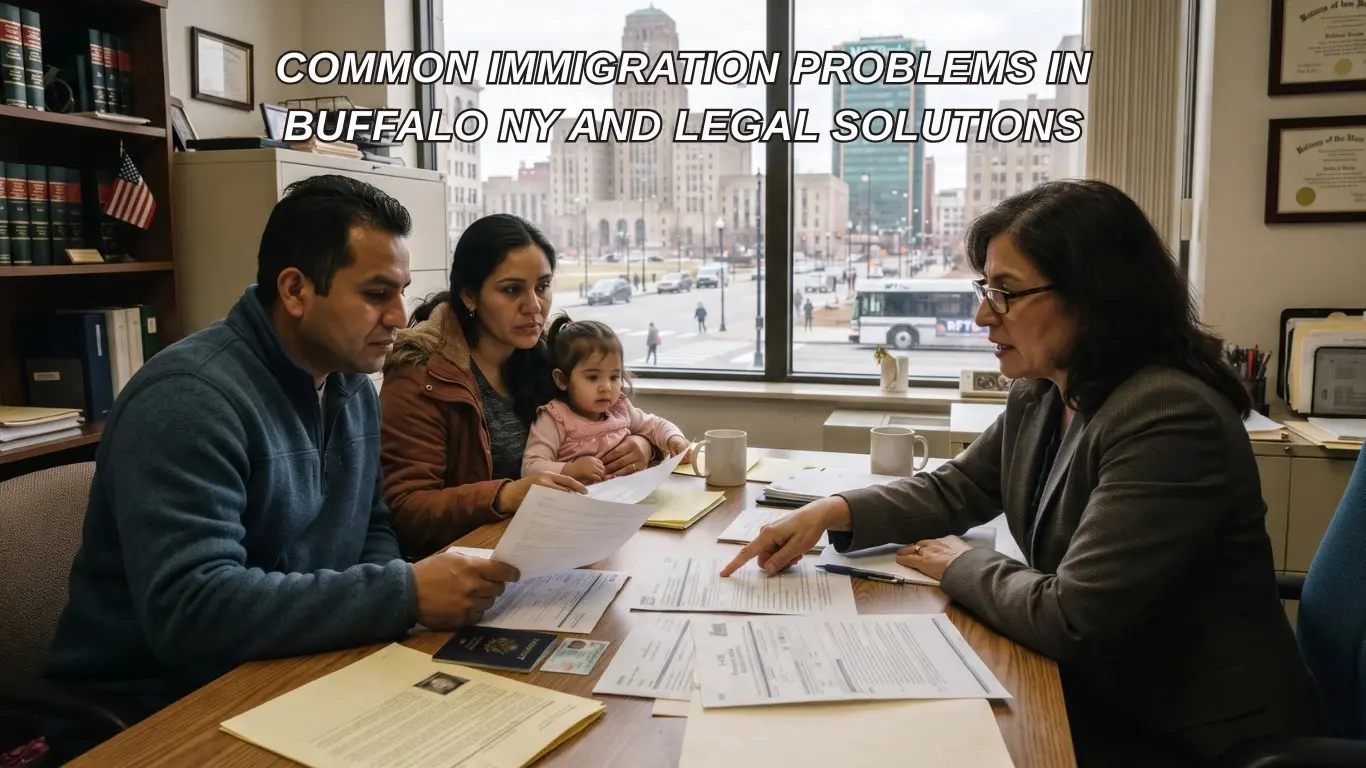
The guide tells about Common Immigration Problems in Buffalo NY and Legal Solutions. Due to its borders with Canada, Buffalo is one of the more complex cities in the U.S. to deal with immigration law matters. Immigrants and refugees in Western New York are confronted with particular immigration struggles, including the influx of immigrants into the region, the pressure to process immigration applications near the Batavia immigration court and detention facility, and the need for fast processing for immigrants in this part of the state. When you or a loved one has been denied a visa, your green card application has stalled, or you’ve received a notice to appear in immigration court, knowing your options and when to seek immigration legal help Buffalo NY can make the difference between a resolved situation and a lengthy and expensive process.
This guide details the most frequent immigration issues that individuals in Buffalo and the surrounding area encounter, and presents the legal options to resolve those issues.
1. Family-Based Green Card Delays
A common gripe with Buffalo immigrants is the lag time for family-sponsored green cards. The processing times for cases are much longer than USCIS estimates, whether a U.S. citizen is petitioning for a spouse, parent, or sibling, or a lawful permanent resident is sponsoring a spouse or child.
Delays are caused by backlogs at the National Visa Center, requests for additional evidence (RFEs), and annual visas available in certain family preference categories. The demand for applications at Buffalo’s regional USCIS field office is consistent, and errors may cause applications to be delayed for months.
Legal solutions:
- Filling a complete, accurate petition from the outset, with all supporting documents to avoid RFEs
- Immediate processing of USCIS cases through the case inquiry process or expedited processing for a valid emergency
- Filing a mandamus lawsuit in federal court, where the case has been pending for far longer than is to be expected without action being taken
- Helping applicants keep up to date with the monthly Visa Bulletin and avoid filing windows to claim priority dates with an attorney
2. Marriage-Based Petition Scrutiny
Sometimes marriages that take place here are subject to additional review scrutiny by USCIS officers who are worried about “sham marriages” with people from the neighboring state of Ontario. Couples may be subject to invasive interviews, a requirement for further substantiation of a valid marriage, or a Notice of Intent to Deny.
Legal solutions:
- Establishing a well-documented “bona fides” file early on joint leases, bank statements, insurance policies, photos, and affidavits from people who know the couple.
- Starting spouses to USCIS interview properly ready
- Quick and adequate response to any Request for Evidence.
- Appealing or filing a motion to reopen/reconsider if a petition is wrongly denied
3. Application for a Travel Document to Leave the United States
A great number of Buffalo immigration issues stem from visa overstays, which frequently occur when individuals do not know how long they are permitted to stay, do not file for an extension for the appropriate time, or a change in status (loss of job, divorce, withdrawal from school) occurs and impacts a person’s legal status. Unlawful presence has serious consequences, with 3-year and 10-year re-entry bars.
Legal solutions:
- Filing extension or change of status before the expiry of the authorized stay, as far as possible
- Submitting a waiver of inadmissibility (I-601 or I-601A provisional waiver) where a reentry bar applies, and the person has a qualifying relative who would suffer extreme hardship
- If eligible, explore other relief measures, including adjustment of status via family or employment petition.
- If abuse is suspected, exploring VAWA self-petitions and/or eligibility for the U visa
4. Detention and Removal Proceedings
Due to its location, people who are arrested by ICE in Buffalo are routinely detained at Western New York’s Batavia Federal Detention Facility, which serves as a detention center for ICE cases taken up in the Immigration Court in Batavia. It’s one of the most stressful times in a family’s life, and time plays an important role.
Legal solutions:
- Seeking a custody redetermination (bond) hearing with an immigration judge to be released from detention before an immigration judge
- Filing applications for relief from removal where applicable, including cancellation of removal, asylum, withholding of removal, or protection under the Convention Against Torture
- Effort to move the case closer to the family or the evidence location by filing a motion to change venue
- Appealing an unfavorable selection to the Board of Immigration Appeals (BIA), and then to the Second Circuit Court of Appeals if the decision is then unfavorable.
- Attorneys can visit clients at the Batavia facility and can facilitate the coordination with detained clients and their families to help collect evidence, file motions, and communicate the status of the case while someone is detained.
5. Asylum Claims and Border-Related Issues
The area is adjacent to Peace Bridge and Rainbow Bridge crossings into Canada, which are areas where there is a high volume of asylum applications, such as people who appear at a port of entry or who are picked up close to the border. Asylum law is complicated, all deadlines are tight, usually one year from arrival (just a few years in certain cases), and credibility is the key.
Legal solutions:
- Filing Form I-589 on time (or substantiating changed or extraordinary circumstances if filing late)
- Constructing a comprehensive, documented history of discrimination or threat of discrimination based on race, religion, country of origin, political beliefs or association with a specific social group.
- Filling in gaps in the credible fear interview and/or merits hearing with complete preparation (asylum claims often fail because of inconsistent testimony)
- No application for work authorization can be made after the case is on file for the necessary number of months. No work authorization application submitted after the case is pending for the required number of months.
- Making and appealing denials under the BIA and seeking federal court review as necessary
6. Employment-Based Visa and Green Card Issues
Foreign healthcare workers, foreign students (and foreign professors at the University at Buffalo), and foreign technology and manufacturing workers are provided essential services to Buffalo’s healthcare systems, universities, and emerging tech and manufacturing companies, and employment-based immigration problems abound, ranging from H-1B denials and PERM delays in labor certification to complications with EB-2 and EB-3 green card sponsorship.
Legal solutions:
- Clearing up the uncertainties of job offer letters, wage determinations, and lab certifications before filing
- Assisting in the drafting of detailed legal responses to RFEs and providing supporting evidence
- Make sure that premium processing is used to shorten processing time if available
- Advising on the maintenance of lawful status for the employer and employee in long-pending green card cases, such as when the H-1B is used beyond the six years on case where an I-140 is pending, etc.
- When appropriate, appealing denials to the Administrative Appeals Office (AAO)
7. Renewal of DACA and Uncertainty
In Buffalo, DACA recipients remain in limbo with the program’s legality subject to a host of ongoing legal challenges. Familiarizing yourself with current filing requirements, missed renewal windows, and changes in eligibility requirements are among the common problems.
Legal solutions:
- Submitting renewal applications quite in advance of the expiration of the current deferred action timeframe (120 to 150 days before)
- Keeping up with cases that could impact eligibility, time limits, and advance parole
- Discussing a DACA recipient’s eligibility for another type of relief (Family/Employment-Based Petition) in light of any change in circumstances since their DACA approval.
- Speaking to a lawyer before traveling outside of the U.S., as advance parole rules for DACA recipients are quite limited, and any error could result in losing status
8. Criminal Charges with Immigration Implications
Immigration consequences are serious and can be severe for a criminal charge or criminal conviction, even a minor one. This is one place where the combination of criminal law and immigration law is particularly unforgiving, and surprises many Buffalo area immigrants.
Legal solutions:
- Talking to an immigration lawyer before accepting any plea deal, as some pleas may be deportable without any further action, while others may not be deportable.
- Petitions for post-conviction relief (vacation of conviction or sentence modification) due to the lack of immigration consequences at the time of a plea
- If waiver of inadmissibility and/or deportability is available, apply for it;
- Close coordination between criminal defense counsel and immigration counsel is something that many defendants do not try until it’s too late
9. Naturalization Denials and Delays
The U.S. citizen application process can be problematic for Buffalo residents for various reasons, such as unpaid taxes, not registering for the Selective Service, missing continuous residence, or problems with the civics and English exam.
Legal solutions:
- Carefully review eligibility before filing, ensuring that continuous residence and physical presence requirements are observed
- Making efforts to resolve any pending tax issues or child support payments in advance, as they may have an impact on “good moral character” determinations
- If you have been denied naturalization, you can appeal by filing a Form N-336.If you were denied naturalization, you can appeal by requesting a hearing on a Form N-336.
- If USCIS does not decide on an application within 120 days after the interview, the petitioner can petition for the agency’s decision in federal district court.
Getting immigration legal help Buffalo NY
Immigration cases don’t happen on their own and a single error, such as missing a deadline, filling out a form incorrectly, or not showing up to court, can be a problem for years to come. From a green card delay to detention, an asylum application denial to simply getting the right direction, immigration legal help Buffalo NY, in the early stages can safeguard your options and your family’s future.
If you are facing any immigration problem in Buffalo, then you should not wait till the deadline is approaching or till a hearing date is fixed on the calendar. Contact someone to talk about your case and see if there is a legal way to go about this.
Conclusion
Immigration issues do not always present themselves in the same manner for each family, with a stalled green card petition being quite different from a loved one at the Batavia immigration detention center, or an asylum case connected to the border vs a DACA renewal. However, the common denominator among almost all of these cases is that deadlines and documentation are critical, and things that are getting off track early on are going to be the biggest issues later.
Fortunately, almost every problem addressed in this book can be addressed legally, from waiver to appeal, bond hearing, or a diligently prepared filing. The difference lies in identifying the problem early and having someone there who knows the law and also the nuances of the Buffalo USCIS field office, such as how they deal with RFEs and how the judges at Batavia make bond requests.
If you or one of your loved ones is experiencing one of the situations listed above, you should not do it on your own. The best way for your family to avoid months, if not years, of unnecessary uncertainty is to obtain immigration legal advice from an attorney who has experience in immigration law as early as possible in the process.
Frequently Asked Questions (FAQs)
1. How much does an immigration lawyer cost in Buffalo, NY?
Costs vary widely depending on the type of case. A straightforward family petition may cost far less than a contested removal case or an asylum claim that requires a full merits hearing. Many Buffalo immigration attorneys offer flat fees for common filings and an initial consultation to review your case and provide a cost estimate before you commit.
2. Where is the Buffalo immigration court located?
Immigration court hearings for the Buffalo area are held at the Batavia Immigration Court, located inside the Buffalo Federal Detention Facility at 4250 Federal Drive, Batavia, NY. Some non-detained cases may also be handled through other regional court settings, so it’s important to confirm your specific hearing location on your notice.
3. How long does it take to get a green card in Buffalo, NY?
Timelines depend on the category. Immediate relative petitions (spouse, parent, or minor child of a U.S. citizen) tend to move faster since there’s no annual cap, while family preference and employment-based categories can take years due to visa bulletin backlogs. An attorney can review your priority date and category to give you a realistic estimate.
4. What happens if ICE detains someone in Buffalo?
Individuals detained by ICE in the Buffalo area are typically held at the Buffalo Federal Detention Facility in Batavia while their case is pending. Detainees are entitled to a custody redetermination (bond) hearing in many cases, and family members or attorneys can call the facility to confirm a detainee’s location and case status.
5. Can I apply for asylum at the Peace Bridge or Rainbow Bridge?
People who present themselves at a U.S. port of entry, including the Peace Bridge or Rainbow Bridge, may express a fear of return and be referred for a credible fear interview as the first step toward an asylum claim. The rules governing entry and asylum processing change frequently, so anyone considering this route should speak with an immigration attorney beforehand.
6. How do I check the status of my immigration case?
For USCIS applications, you can check status online using your receipt number. For cases in immigration court, including those at Batavia, you can use the EOIR automated case information system by phone or online with your alien registration number. An attorney can also request updates directly.
7. Where is the USCIS field office in Buffalo, and do I need an appointment?
USCIS handles interviews and biometrics for the Buffalo region through its local field office, and appointments are generally scheduled by USCIS itself based on your pending application walk-ins are not accepted except in limited emergency circumstances through the online appointment system (InfoPass).
8. Do I need a lawyer for my USCIS interview?
It’s not legally required, but it’s strongly recommended, especially for marriage-based green card interviews, which often involve detailed questioning. An attorney can prepare you for likely questions, ensure your documentation is complete, and be present at the interview to address any issues that arise in real time.
9. How can I find out if a family member is being held at the Batavia detention facility?
You can call the facility directly during business hours with the detainee’s full legal name, date of birth, and country of origin. Detainees cannot receive incoming calls, so this is typically the fastest way for family members to confirm someone’s location and begin the process of contacting them or arranging legal representation.
10. What should I do if I receive a Notice to Appear (NTA)?
A Notice to Appear places you into removal proceedings before an immigration judge. You should contact an immigration attorney immediately — do not miss your hearing date, as failing to appear can result in an automatic order of removal issued in your absence. An attorney can review your NTA for legal defects, assess what forms of relief you may qualify for, and represent you in court.