


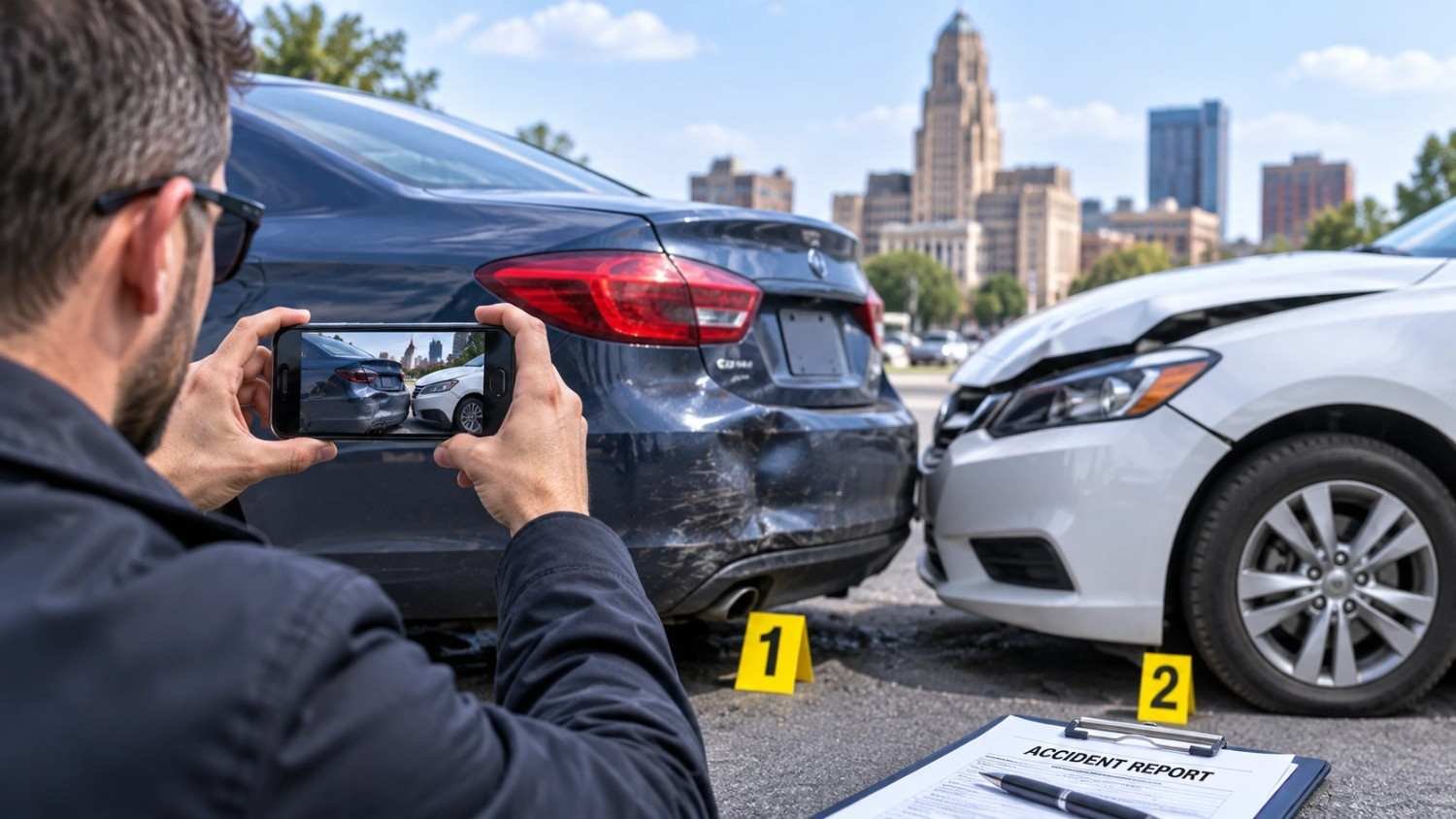
Car Accident Lawyers: How Rear-End Collision Evidence Can Affect Liability is a relevant topic for drivers who need to understand how evidence from a rear-end crash can influence an insurance claim or legal dispute. A back-to-back collision does not necessarily mean that a driver is presumed negligent on his own, but there are many situations that suggest that a driver is negligent. The actions of vehicles, road conditions, photographs, witness accounts and other traffic evidence can contribute to an understanding of how an accident occurred.
The cause of a rear-end accident Buffalo drivers get involved in can be a sudden stop, a chain reaction collision, an unexpected lane change, or a vehicle that was damaged prior to impact. Different questions of fault and responsibility can arise in each of the situations. Identifying and knowing what steps are involved in the collection and preservation of evidence, as well as its interpretation, can be beneficial to an injured driver’s next steps.
Car accident lawyers Buffalo, NY can examine the evidence, determine which facts may be in dispute, and explain how the New York negligence rules may apply to a specific case. This guide is not just about what to do after an accident, but it’s about collision evidence and the role it plays in determining liability.
Why Rear-End Collision Liability Is Not Always Straightforward
Rear-end crashes are frequently considered a simple collision where one car hits another car in the back. However, the circumstances leading up to the impact may be more complicated than they initially seem.
In New York, the typical standard of care and following distance for drivers. If the collision is a rear-end collision with either a moving or stopped vehicle, it may be inferred that the subsequent driver was negligent. But the facts do count and the other driver’s actions could be a factor.
For example, a vehicle could be driving in another lane and suddenly move over to the lane of the other driver, a vehicle may come to a halt in the middle of the road or it may back up into another vehicle. Sometimes there are more than one collision in a multi-vehicle accident, and each collision may require investigation.
Evidence can be used to differentiate between what is known and what each driver believes to have happened.
How New York’s Rear-End Collision Rule May Apply
The courts of New York have previously held that a “rider-whack” collision with a stopped car can provide a prima facie case of negligence against the car’s driver. The next vehicle driver may have to give a non-negligent explanation for the accident.
This does not necessarily mean that all rear collisions are considered 100% driver error, however. The surrounding circumstances may have an influence on the evaluation of the claim.
For example, if the front driver suddenly and unexpectedly stopped, that may be a factor in the investigation. Whether or not the outcome will be changed will depend on the evidence and the legal principles applicable.
A driver must not assume a police report or the vehicles’ positions or the initial insurance determination will answer all questions of fault.
What Types of Evidence Can Affect Rear-End Collision Liability?
Various types of evidence can be used to determine vehicle positions, time of impact, driver behavior, and impact sequence. The best evidence is often provided by a combination of sources that tell the same story of the collision.
1. Dashcam Footage
The seconds before a collision can be captured in a visual format with the help of dashcam footage. Depending on the position of the camera and recording quality, it may display:
- The distance between vehicles before impact.
- Sudden braking or lane changes.
- Traffic signals and surrounding vehicles.
- Road conditions and visibility.
- The sequence of impacts in a multi-car crash.
- Whether a driver appeared to have time to respond.
Video can be particularly helpful if the drivers provide conflicting narratives about how the accident occurred.
But a camera can’t tell it all. The angle may not reveal a vehicle in a lane beside the road, the recording may begin too late, or the distance and/or speed may not be obvious from the video.
If there is relevant footage of the driver, that should be saved as is and not edited. They should also see if the camera saves the old photos over the new ones.
2. Vehicle Damage Evidence
The vehicle damage evidence can aid in determining the point of impact and the direction of the impact.
Photographs of damaged bumpers, trunk panels, rear lights, license plates, etc., may assist in indicating the extent and location of obvious damage.
For example, if the damage is at the back of one car and the front of another, then it could be a rear-end collision. When a multi-vehicle accident occurs, the damage patterns can assist investigators in figuring out where the first impact was followed by subsequent impacts.
But damage to the vehicles does not provide evidence of all the facts of the crash. Damage appearance can be affected by the design of the vehicle, impact angle, multiple impacts, body repairs, and other factors.
When there’s a question about the sequence of events, a qualified accident reconstruction professional might need to review the vehicles, the measurements and the other evidence.
3. Electronic Vehicle Data
Event Data Recorders or other electronic systems in some vehicles may provide a certain amount of vehicle information around a collision.
Vehicle speed, braking, acceleration, seatbelts or velocity changes, depending on the vehicles and system, may be relevant.
The information available varies depending on vehicle model, the configuration of the system, the type of event recorded and the event condition. Not all vehicles will contain all of this information and accessing the data may require a special tool.
Electronic data may be used as part of a driver’s account, but can be used in conjunction with other evidence. A recorded value does not necessarily provide an explanation of a driver’s behaviour.
Access can also be an issue of law, technology or ownership. If electronic data is of significance to a claim, a lawyer and/or qualified expert can advise on proper preservation and retrieval.
4. Traffic Camera and Nearby Business Footage
A collision or events that may have led up to the collision can be recorded on traffic cameras and security systems.
Potential sources include:
- Traffic monitoring cameras.
- Cameras at nearby shops or office buildings.
- Parking facility surveillance systems.
- Residential security cameras.
- Commercial delivery vehicle cameras.
This video footage may prove helpful if there is no dash camera in either driver’s car or if the accident took place at an intersection.
The main challenge is availability. Some systems record continuously, while others only save footage when movement is detected. Recordings may also be automatically deleted after a short retention period.
If a nearby camera might have recorded the collision, the quick identification of the camera and request for preservation of the evidence may prevent loss of potentially useful information.
How Vehicle Damage Evidence Can Reveal the Sequence of Impacts
A rear-end collision between two cars might seem like a simple scenario, but it isn’t always. This same situation can be much harder if the incident involves three or more vehicles.
Think of three cars on the road going in the same direction. The middle vehicle bumps into the front vehicle as the rear vehicle collides with the middle vehicle. Each driver will have their own opinion on whether or not the middle car was already stopped, whether the front car suddenly braked, or whether the first impact caused all subsequent damage.
Investigators might need to compare:
- Damage locations on each vehicle.
- The height and alignment of contact points.
- Paint transfer and broken vehicle components.
- Photographs taken before vehicles were moved.
- Statements from drivers and witnesses.
- Available camera footage.
- Vehicle data and physical measurements.
The following information can be used to help determine the sequence of impacts. However, the pattern of damage does not always provide all the answers, and sometimes an expert is required to interpret the evidence when it’s complicated.
Why Photographs Taken at the Scene Matter
Photos that are taken right after the accident can capture information that will go away once vehicles are moved or repaired.
Safe photographs can include several images of the vehicles from various perspectives, their relative orientation, intersections in the immediate vicinity, skid marks, debris, road markings, traffic signs, and weather and visibility conditions, if appropriate.
Police, or anyone else, should never put themselves in traffic or delay emergency assistance in order to get photos. The primary considerations are safety and medical requirements.
Where it is not possible to take photographs at the scene, this may be supplemented by images taken in a tow yard or repair facility, but not necessarily captured in the original positions of the vehicles.
How Witness Statements Can Support or Challenge Liability
Witnesses can give their own side of the story regarding events that may have occurred prior to collisions. Their observations can be used to fill in missing information in photographs or electronic records.
Witnesses may have seen vehicles changing lanes just before the accident or noticed the traffic signal or that one vehicle was stopped for a considerable amount of time.
The value of a witness statement is dependent upon what it is the witness actually saw. There might be someone nearby who witnessed the crash but did not witness the events that came before it.
Investigators may consider:
- Where the witness was located.
- Whether the witness had an unobstructed view.
- How long the witness observed the vehicles.
- Whether the account is consistent with other evidence.
- Whether the witness is describing a direct observation or an assumption.
Gaining the name and contact details of a witness may help to capture the opportunity of following up in the future. Witnesses must be encouraged to tell the truth, not what is expected of them.
Can Road Conditions Change the Liability Assessment?
Winter driving conditions can bring snow, slush, ice, decreased visibility, and slippery roads to Buffalo drivers. These situations may impact stopping distance and control ability.
Weather may be a factor in deciding if a driver acted reasonably under the circumstances. But inclement weather conditions are not a complete defense to a rear-end collision.
The general rule for drivers is to adapt their speed, following distance and driving practice to the conditions. Evidence can assist in deciding if a driver took reasonable precautions.
Snow and Ice Evidence
If a collision does happen on a snow-covered or icy street, some useful evidence may be:
- Photographs of the road surface.
- Weather observations and reports.
- Records of road treatment, where available.
- Tire and vehicle condition information.
- Dashcam footage showing visibility and traffic movement.
- Witness accounts of vehicle behavior before impact.
Road conditions are often rapidly changing. Snow can be removed, ice can melt, and vehicle tracks can be erased. Documenting this on time can thus be beneficial.
Sudden Braking in Poor Weather
When someone brakes suddenly, it could mean that they are reacting to a hazard, traffic signal, pedestrian or vehicle in front of them. If the other driver says he or she did not expect the stop, it is all about the brakes.
Investigators may examine whether the driver had a legitimate reason to stop and whether the following driver maintained an appropriate distance for the conditions.
These facts are of legal importance, but only when viewed in the context of the overall situation and not just because the brakes were applied.
What Happens When Both Drivers May Share Fault?
New York has a pure comparative negligence system. An injured party’s compensation can be modified in accordance with the percentage of liability assigned to that party according to the rules and facts of the case.
For example, suppose a claimant’s proven damages are $100,000 and the claimant is found 20% responsible for the collision. A simplified calculation would reduce the amount by $20,000, leaving $80,000 before considering other legal issues, applicable insurance rules, or offsets.
This is illustrative only and does not represent a prediction of any court or insurer.
Rear-end collisions may involve shared fault arguments if more than one driver’s actions were determined to have been responsible for the accident, based on the evidence. The evidence may be related to an unsafe lane change, unexpected action, following distance, speed or another related situation.
A car accident lawyers Buffalo, NY can learn the facts and help determine if there is any evidence to support a comparative negligence argument.
How Police Reports and Insurance Investigations Use Traffic Evidence
A police report can include the details of the crash and include the names of the drivers and witnesses involved, as well as what the police officer saw when arriving at the scene of the crash. It can also contain diagrams, statements, or information about traffic offenses depending on the situation.
A police report does not always provide a full picture of what happened in a crash though. Officers might end up after the vehicles have been moved, not see the hit, or not have the electronic data and surveillance footage.
The insurance companies will investigate their own case and determine if there was liability and the amount of damages. They can look through pictures, work through the repair estimates, statements, medical records, witness statements, and video footage available.
If there is a dispute over the drivers’ accounts, the insurer might want to seek further details from the drivers or seek clarification from a specialist.
What If the Insurance Company Disagrees With Your Account?
If an insurance company does not agree on the circumstances surrounding the collision, compile the evidence and determine what point they do not agree with.
For instance, the issue could involve whether a vehicle stopped before the accident, who started a chain of events, or if a lane change played a role in the accident.
A clear timeline, with photos, witness statements and appropriate recordings, might be helpful in answering these questions. Do not manipulate evidence or draw inferences about evidence in a recording.
When in doubt about an insurance statement or insurance settlement offer, it is best to get legal advice first.
When Should You Contact a Rear-End Collision Attorney?
A lawyer might be of great assistance in cases where there is a dispute about who is at fault, if injuries are severe, multiple vehicles are involved, or significant evidence is likely to be lost.
A rear-end collision lawyer can assist you in determining the evidence involved, reaching out to insurance companies, examining liability evidence, and deciding if expert analysis is needed.
Consider seeking legal advice when:
- The other driver denies responsibility.
- Several vehicles were involved.
- Dashcam or surveillance footage may be overwritten.
- The insurer claims you contributed to the collision.
- Vehicle damage patterns are inconsistent with the reported sequence.
- Your injuries or financial losses are substantial.
- You receive a request for a recorded statement and are unsure how to respond.
- A settlement offer does not appear to account for your documented losses.
A lawyer cannot guarantee a particular result. The level of damages, or the strength of a claim, is dependent upon the evidence, the law applicable, the injuries sustained and insurance coverage, as well as other facts of the case.
How to Preserve Evidence After a Rear-End Accident in Buffalo
Preserving evidence is crucial as photos, recordings, and witness recollections can fade away.
Save Original Files
Preserve original photographs, videos, and digital files as much as possible. Keep relevant dashcam footage before it gets erased and keep copies of dashcam footage.
Don’t make any edits or annotations to the only copy of a recording. When sharing a clip, keep the original file and record the date and source of where it came from.
Keep Repair and Insurance Records
Record repair estimates, towing records, rental vehicle receipts, insurer correspondence and photos of the vehicle condition.
Where possible and safe, seek the advice of the relevant expert or legal professional regarding preservation before allowing the vehicle to be repaired where it may be required to preserve any evidence.
Record Witness Information
Record the names of witnesses and contact information (if available) and a note of what each witness reported seeing. Differentiate between what they have seen and what they think they have seen.
Maintain a Timeline
A simple timeline can help organize events, including the date and location of the crash, when photographs were taken, when the vehicle was inspected, and when the insurer was contacted.
Keep the timeline factual. If you are uncertain about a detail, label it as uncertain rather than filling in the gap with a guess.
New York Deadlines and Other Legal Considerations
Evidence is only one part of a car crash case. New York rules affect no-fault benefits, liability claims, and lawsuits.
Within New York’s no-fault system, an eligible occupant, in most cases, must obtain certain initial economic loss benefits from the appropriate no-fault insurer, unless the statute’s exceptions or requirements are met. The no-fault application must be submitted within 30 days of the accident unless a valid exception is in place.
There could be a separate time limit for a personal injury action. In most regular personal injury cases in New York, the limitation period is three years; however, there are exceptions and shorter deadlines, including in some cases involving a government entity.
Don’t make the mistake of assuming that all parts of a claim have the same deadline. Requirements may vary from party to party, between various types of losses, and among various forms of legal support. It helps to get expert legal advice to find out which deadlines are applicable to your case.
Conclusion
In rear-end crashes, it may not only be a question of who hit whom. It can help determine the sequence of events with the evidence of the vehicles, dashcam videos, witness statements, electronic data and road conditions, and determine if one or more of the drivers was responsible for the crash.
It can be easier for any party involved in a rear-end accident Buffalo to resolve disputes with an insurance company if they have the original evidence and keep good records. If the facts are in dispute, a rear-end collision attorney may be able to help determine the facts and discuss the potential implications of New York liability law.
In a review scenario, concentrate on the verifiable evidence and not on assumptions based on vehicle positioning or damage only. Each accident is unique, and the results are dependent on the facts, law and insurance situation.
Frequently Asked Questions
1. Is the rear driver always at fault in a Buffalo rear-end accident?
No. A rear-end impact may support an inference of negligence against the following driver, but the full circumstances and available evidence determine how liability is evaluated.
2. What evidence is most useful in a rear-end collision claim?
Dashcam footage, photographs, witness statements, vehicle damage records, traffic camera recordings, and available electronic vehicle data may all help establish what happened.
3. Can vehicle damage prove who caused a rear-end accident?
Vehicle damage can help explain contact points and impact sequences, but it does not always establish fault by itself. Other evidence may be necessary.
4. Can snow or ice affect liability in Buffalo?
Yes. Weather and road conditions may help explain stopping distances and vehicle control. Drivers are still expected to use reasonable care under the conditions.
5. What if a driver suddenly stops before being hit from behind?
The reason for the stop, surrounding traffic, and following distance may all be relevant. A sudden stop does not automatically determine which driver is liable.
6. Can dashcam footage be used in an insurance claim?
Potentially, yes. Relevant footage may help establish the sequence of events, provided its authenticity and context can be assessed.
7. How can I obtain nearby traffic camera footage?
Identify potentially relevant cameras and contact the appropriate owner or authority promptly. Availability and access depend on the recording system, retention policy, and applicable rules.
8. What if several vehicles are involved in a rear-end collision?
Investigators may need to determine the order of impacts and assess each driver’s conduct separately. Damage photographs, recordings, witness statements, and expert analysis may help.
9. Can I still recover compensation if I share some fault?
New York generally applies pure comparative negligence, meaning an award may be reduced according to the claimant’s share of fault. Other legal and insurance rules may also affect recovery.
10. When should I contact car accident lawyers in Buffalo, NY?
Consider contacting a lawyer when fault is disputed, injuries are serious, multiple vehicles are involved, or important evidence may disappear. Legal advice can help clarify your options and relevant deadlines.