


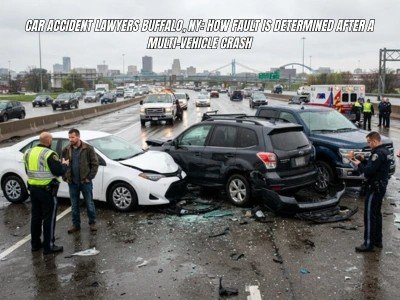
Car accident lawyers Buffalo, NY: How fault is determined after a Multi-Vehicle crash can be a complicated issue, as multiple drivers, vehicles, and factors can be involved in the same accident. A multi-vehicle crash can be complicated by a number of impacts that occur in seconds, and knowing what actually occurred can be tricky.
In most cases, determining fault requires a review of the actions of both drivers, the nature of the crash, road and weather conditions, evidence available, and New York law. Evidence in the investigation can include police reports, photos, witness statements, vehicle damage, traffic camera footage, or other evidence.
Knowing what information is looked at by the fault party can help those who are involved in a multi-vehicle accident understand what information they should pay attention to when it comes to a claim or legal action.
What Is a Multi-Vehicle Crash?
A Multi-vehicle Crash is a crash with three or more vehicles where the vehicles are involved in the same crash event. Crashes are possible and occur in various ways. For instance, one car could back into another, forcing the other car into traffic, where it would strike the third car.
The other scenario can be more than one vehicle approaching an intersection at the same time; a vehicle fails to stop, and a series of crashes occurs.
Another way that multiple vehicles may crash is when multiple vehicles brake at the same time on a highway. The number of vehicles involved does not automatically determine who is responsible. Investigators need to examine how each vehicle became involved.
Why Fault Can Be Difficult to Determine
In a typical two-car accident, investigators will only need to compare the actions of two drivers.
There are various questions in a multi-car accident Buffalo case:
- Who caused the first impact?
- Did another driver have enough time to stop?
- Did a driver follow too closely?
- Did a vehicle change lanes improperly?
- Did another crash make the later impact unavoidable?
- Were traffic signals involved?
- Did weather or road conditions contribute?
- Did any driver violate a traffic rule?
The answer may not always be that one driver is entirely responsible.
Depending on the circumstances of the accident, multiple drivers might be at fault.
The First Impact Does Not Always Tell the Whole Story
A frequent error is believing that the driver responsible for the first crash is liable for all subsequent crashes.
For a simple example, A driver has to brake in a hurry when an unexpected hazard is encountered by the driver of Vehicle A. Vehicle B follows Vehicle A so closely that it crashes into Vehicle A. Vehicle A crashes with Vehicle C.
The investigation may require that the chain of events be traced back to see if Vehicle B contributed to the events and if another driver contributed to the events. It is the facts that matter. This is why a detailed crash investigation can be important after a serious multi-vehicle crash.
How Police Investigate a Multi-Vehicle Crash
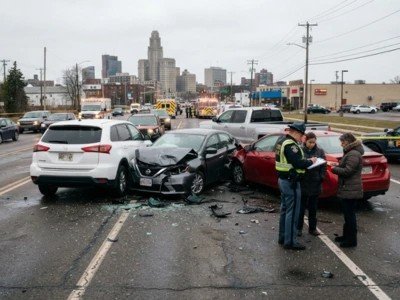
When a serious crash occurs, police officers can record the details of the accident and obtain information from the individuals involved.
An investigation can involve:
- Driver statements
- Passenger statements
- Witness accounts
- Vehicle positions
- Vehicle damage
- Skid marks
- Debris locations
- Traffic signals
- Road conditions
- Weather conditions
- Available video footage
The police will also be able to draft an accident report that will outline the events as they know them at the time.
While a police report can be some evidence, it may not provide all the information that is necessary to determine civil liability.
Statements From Drivers and Witnesses
Remembering the accident can be different for people involved in a crash.
In the case of a multi-vehicle crash, things can occur rather rapidly. One driver might witness the first crash but not the subsequent crash behind several vehicles.
A witness can be used to give more details on:
- Vehicle speed
- Lane position
- Traffic signals
- Sudden lane changes
- Following distance
- Driver behavior
- The sequence of impacts
Witness evidence should be assessed in the context of other evidence, not on its own.
Photographs and Videos From the Crash Scene
Photographs can capture information that can be lost after vehicles are relocated and the roadway is graded.
Useful photographs may demonstrate:
- Vehicle damage
- Vehicle positions
- Skid marks
- Road debris
- Traffic signs
- Traffic signals
- Road markings
- Weather conditions
- Nearby intersections
- Damage to roadside objects
Other recordings may include dashcam, traffic cameras, business security cameras and more, which can help establish what occurred.
Video may be of special value in instances where multiple impacts happen in a consecutive manner.
Vehicle Damage Can Help Reconstruct the Crash
The extent and location of vehicle damage can provide clues as to how the crash occurred.
The front of one car could be damaged, and the rear of another could be damaged, for instance, to corroborate a specific scenario.
Damage to the vehicle is not, however, by itself a basis for liability. Investigators might have to take into account methods of travel, vehicle positions, speed, braking, road conditions, etc.
If the accident was severe, accident reconstruction can be used to ascertain more information regarding the accident.
Accident Reconstruction
Accident reconstruction is the process used to look at the physical evidence and other information to find out how the accident may have happened.
A reconstruction analysis can include:
- Vehicle damage
- Skid marks
- Vehicle weight
- Road geometry
- Vehicle positions
- Speed estimates
- Braking
- Impact angles
- Video footage
- Witness statements
Its aim is to create a logical order of events from the evidence. A formal reconstruction is not required in all cases of accidents. The need is dependent on the complexity and severity of the crash.
How New York Fault Rules Can Affect a Claim
New York is a comparative negligence state. With a civil claim, there may be several parties liable for certain percentages. For example, if a person is determined to be partly at fault in an accident, his or her recovery could be impacted by the percentage of fault in New York.
This means that in multi-vehicle accidents, accident liability NY questions come in very handy. Because the application of comparative negligence depends on the specific facts and legal claims involved, people should not assume that being partially responsible automatically eliminates a claim.
What Does Comparative Negligence Mean?
Comparative negligence is when multiple parties may be responsible for an accident.
Suppose there are three drivers in a possible scenario.
An investigation could determine that:
- Driver A contributed 20%
- Driver B contributed 50%
- Driver C contributed 30%
The percentages in this example are only for illustration. Actual responsibility will be determined based on evidence and applicable law.
What is important is that an all-or-nothing determination is not always the result of a multi-vehicle crash.
Driver Behavior and Traffic Violations
Investigators can look to see if any driver was breaking traffic laws or if they were in any way endangering others.
Some problems that can arise are:
- Speeding
- Following too closely
- Failing to yield
- Running a red light
- Improper lane changes
- Distracted driving
- Unsafe turns
- Failure to maintain control
A traffic violation may be relevant evidence, but, depending upon the circumstances and the claim, the legal value of a specific violation may vary.
Weather and Road Conditions
Snow, ice, rain, and other weather conditions that make driving difficult can occur in Buffalo and Western New York. A driver’s actions are not excused just because of weather. Drivers are normally assumed to drive their car in the proper manner given the circumstances.
For example, on icy roads, a driver might need to slow down and increase their following distance. Weather conditions may be a factor that investigators will consider when determining the cause of a crash related to the environment, vehicle control, stopping distances, or visibility.
The Role of Following Distance
In chain reactions, following distance may be particularly crucial.
When a vehicle is following too closely behind another vehicle, the driver might not have enough time to slow down or stop if traffic suddenly slows or stops.
Investigators may examine:
- Traffic speed
- Distance between vehicles
- Brake lights
- Road conditions
- Visibility
- Reaction time
- Evidence of braking
These factors can be considered in determining if a subsequent party had a reasonable chance to avoid the accident.
Lane Changes and Merging
Multi-vehicle crashes can also occur due to unsafe lane changes. A driver can move into another lane without realizing that there is someone else driving in that lane. This can result in a further crash involving one or both vehicles.
Evidence may include:
- Vehicle damage
- Dashcam footage
- Witness statements
- Lane markings
- Vehicle positions
- Traffic camera recordings
The investigation could be directed to what caused the driver to begin the movement and whether other drivers could have avoided the crash.
Traffic Signals and Intersections
Three or more vehicles may be involved in an intersection crash, which can make them difficult to investigate.
Investigators might have to figure out:
- Which vehicles had a green or red light
- Whether a driver failed to yield
- Whether a turn was permitted
- Whether a signal malfunctioned
- Where each vehicle was positioned
When events are in question, traffic camera footage or witness statements might be of special value.
Evidence From Cell Phones and Electronic Data
In some instances, electronic information can be used as evidence.
Investigators can review data about:
- Phone use
- Vehicle systems
- Navigation
- Event data recorders
- Dashcams
The availability and usefulness of this information vary from one vehicle and case to another. Electronic evidence should also be treated with care, as privacy and legal issues may be relevant.
Insurance Companies and Fault Investigations
Following an accident, insurance companies might investigate themselves.
They may review:
- Police reports
- Statements
- Photographs
- Vehicle damage
- Medical records
- Witness information
- Other available evidence
Insurance companies have their own interests to consider when assessing claims and may use different information to answer the questions of legal responsibility. Documentation may be of value after a serious crash for one reason.
What a Car Accident Attorney Buffalo Can Do
A car accident attorney Buffalo can assist in organizing the evidence and determining the significance of the facts in a potential claim.
Your attorney might:
- Review the accident report
- Collision relevant records
- Communicate with insurance companies
- Review available photographs and videos
- Identify potential witnesses
- Evaluate liability issues
- Work with accident reconstruction professionals when appropriate
- Assess damages
- Handle settlement discussions
- Prepare the case for litigation if necessary
The specifics of the services will vary based on the circumstances of the collision.
What Information Should You Preserve?
When a multi-vehicle accident happens, individuals ought to keep relevant information to them if possible.
This may include:
- Photos of the vehicles
- Photos of the accident scene
- Insurance information
- Driver information
- Witness contact details
- Police report information
- Medical records
- Medical bills
- Repair estimates
- Dashcam recordings
- Relevant messages or correspondence
Do not delete potentially relevant photographs, videos, or other records.
Why Medical Documentation Matters
Fault and damages do not overlap. The investigation may help to determine which party was responsible for the crash, but a claim with injuries also needs evidence about the injuries and resulting losses.
Medical documentation can be used to establish:
- The nature of an injury
- Treatment received
- Medical expenses
- Recommended follow-up care
- Time away from work
- Other consequences associated with the injury
If someone is injured or has symptoms following a crash, they should seek appropriate medical attention.
What Happens When Multiple Insurance Policies Are Involved?
Many insurance policies can apply to a multi-vehicle crash.
Insurer investigations of the possibility of their policyholder’s fault may become more complex in cases where multiple drivers are involved in claims.
Some questions can be raised, including but not limited to:
- Which driver caused the collision
- How responsibility is divided
- Which policies may apply
- Whether coverage limits are sufficient
- Whether additional claims may be available
Answers will vary based on the facts, policies, injuries, and law.
What If a Driver Claims You Caused the Crash?
The driver or insurance company may see things differently regarding what happened in the accident. This isn’t always the solution.
Photos, videos, witness accounts, vehicle damage, police reports, and other evidence can be used to examine alternate points of view. Don’t alter or remove evidence because another person reports a different event.
Why Timing Can Matter After a Crash
It can be more difficult to get evidence later on.
Vehicles could be repaired or lost, surveillance tapes may be missed or permanently erased, and witnesses may be harder to find.
It can be helpful to record the collision and take note of relevant information as soon as reasonably possible for this reason.
However, there are also other types of claims in New York that have legal deadlines, so it is important for anyone who may wish to file a claim to be aware of those deadlines.
Common Mistakes After a Multi-Vehicle Collision
A tough claim may be made more difficult to investigate by people without an intention to do so.
Common problems include:
- Leaving the scene without exchanging required information
- Failing to document visible damage
- Deleting photographs or videos
- Ignoring medical symptoms
- Assuming the first driver involved is automatically at fault
- Giving inconsistent accounts of the accident
- Accepting a settlement without understanding what it covers
- Waiting too long to investigate potential evidence
The action to take depends on the situation of the crash.
What Makes a Multi-Vehicle Investigation Different?
The distinction is in the number of relationships between vehicles.
Investigators may need to determine not only whether Driver A caused an impact with Driver B, but also whether that impact caused Driver B to hit Driver C.
This creates a chain of events that must be examined carefully.
For example:
Driver A changes lanes → Driver B brakes suddenly → Driver C rear-ends Driver B → Driver B moves into Driver D
| Evidence Considered | What It Can Help Show |
| Police reports | Details recorded about the crash and statements collected at the scene |
| Vehicle damage | Possible impact points and how vehicles may have collided |
| Witness statements | Vehicle movements, traffic signals, braking, and the sequence of impacts |
| Photos and videos | Vehicle positions, road conditions, damage, and events before or during the crash |
| Skid marks and debris | Possible braking, vehicle movement, and impact locations |
| Traffic camera footage | Vehicle movements, signals, lane changes, and timing of impacts |
| Weather and road conditions | Whether snow, ice, rain, visibility, or road conditions contributed |
| Electronic data | Information from dashcams, vehicle systems, navigation, or event data recorders |
There could be a different liability question for each step.
When a Detailed Investigation May Be Important
A detailed investigation may be relevant particularly when:
- Multiple drivers give different accounts
- Injuries are serious
- The collision involved several impacts
- Liability is disputed
- Insurance companies disagree about responsibility
- Video evidence exists
- Vehicle damage is extensive
- A traffic violation is disputed
- Several insurance policies may be involved
Typically, the extent of investigation required will depend on the complexity of the collision.
How to Approach Fault After a Multi-Vehicle Crash
Use evidence rather than assumptions to determine fault. It doesn’t mean that a vehicle was hit from behind in a chain-reaction accident means that it’s because of that collision that all the other vehicles were hit.
Likewise, the initial or final impact does not necessarily guarantee legal liability. The whole chain of events should be looked at carefully.
Final Thoughts
Car Accident Lawyers Buffalo, NY: How Fault Is Determined After a Multi-Vehicle Crash involves examining the full sequence of events rather than focusing on only one impact. Police reports, photographs, witness statements, vehicle damage, video recordings, road conditions, and other evidence may help establish how the collision occurred.
New York comparative negligence rules can also make liability more complex when multiple people may have contributed to a crash. Understanding the evidence and preserving important records can therefore be valuable after a serious multi-vehicle collision.
If fault or liability is disputed, a car accident attorney Buffalo residents consult can review the circumstances, explain the applicable legal issues, and help determine what evidence may be relevant to the claim.
FAQs
1. Can three or more drivers all be responsible for the same crash?
Yes. Depending on the evidence, multiple drivers may potentially share responsibility for different parts of a multi-vehicle collision.
2. Does the driver who caused the first crash pay for every vehicle involved?
Not necessarily. Responsibility depends on the sequence of events and the contribution of each driver to the resulting collisions.
3. Can a passenger be an important witness in a multi-car crash?
Yes. Passengers may have observed traffic signals, vehicle movements, braking, or other details relevant to determining what happened.
4. Can a damaged vehicle be inspected before it is repaired?
In some disputed cases, preserving and documenting vehicle damage before repairs can be important for investigating how the collision occurred.
5. Can dashcam footage change the understanding of a crash?
Yes. Clear video may provide information about vehicle movements, traffic signals, speed, braking, and the timing of impacts.
6. Can road construction contribute to a multi-vehicle collision?
Potentially. Construction zones can change lane patterns, signage, traffic flow, and road conditions, which may become relevant when investigating a collision.
7. Does a police citation automatically prove civil liability?
Not necessarily. A citation can be relevant evidence, but civil liability involves the facts and legal issues applicable to the particular claim.
8. Can a vehicle’s black box contain useful crash information?
Some vehicles have event data recording systems that may contain information about vehicle operation around certain crashes. Availability varies by vehicle.
9. What if one driver leaves before police arrive?
Leaving the scene can create additional legal issues, and the remaining evidence may become particularly important in determining what happened.
10. Can weather be considered when determining fault?
Yes. Investigators may consider snow, ice, rain, visibility, and other conditions when evaluating how drivers operated their vehicles.